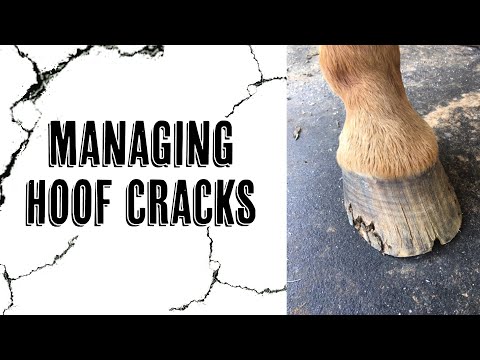
Types of Hoof Cracks
Cracks are classified by location, depth, and direction. Each type has different causes, risks, and treatment approaches.
Grass Crack
The most common and least serious hoof crack — a thin, shallow vertical crack that starts at the ground surface of the hoof wall and travels upward a short distance. Grass cracks are caused by alternating wet-dry conditions that cause the hoof wall to expand and contract, and by long trimming intervals that allow the wall to chip and flake at the bottom edge. They do not reach sensitive tissue and cause no lameness. Most resolve with the next trim — the farrier removes the wall to the level of the crack's top and the new horn grows in cleanly. A small notch filed horizontally at the top of the crack (a "stress relief groove") stops the crack from propagating upward.
Sand Crack
A vertical crack that originates at the coronary band and grows downward as the hoof grows. Sand cracks are more serious than grass cracks because they begin at the horn-producing tissue — often indicating coronary band damage, a previous injury to the coronary band, or a scar that produces abnormal horn. As new wall grows down from the damaged coronary band, the defect propagates with it. The crack can deepen over time and, if it reaches the middle third of the wall, may begin to move under load and potentially involve sensitive tissue. Treatment focuses on protecting and stimulating the coronary band and stabilizing the crack below.
Toe Crack
A vertical crack in the front (toe) region of the hoof wall. Toe cracks are commonly caused by excessive toe length — the long lever arm concentrates stress at the toe wall during breakover, splitting the horn fibers. They can also result from previous white line disease, laminitic wall distortion, or direct trauma. Superficial toe cracks causing no lameness are managed with corrective trimming (shortening the toe to reduce leverage) and a stress relief groove at the crack's upper end. Deep toe cracks that extend through the full wall thickness or reach sensitive tissue require composite repair and often a shoe modification to unload the crack during healing.
Quarter Crack
The most serious and most challenging hoof crack. A quarter crack runs vertically through the quarter of the hoof wall — the area where the wall curves from toe to heel. Quarter cracks are serious because the quarter region flexes significantly with every stride, causing the crack edges to move against each other (shear movement). This movement prevents healing, causes pain, can trap debris and bacteria, and may expose or damage the sensitive corium underneath. Quarter cracks frequently bleed and cause lameness. They are caused by imbalance (medial-lateral imbalance causing one side of the foot to be chronically overloaded), thin walls, contracted heels, or previous coronary band damage. Repair requires a skilled farrier using composite patch systems and specific shoeing to eliminate crack movement.
Heel Crack
Cracks in the heel bulb region, typically horizontal rather than vertical. Heel cracks are often caused by sheared heels (one heel bulb significantly higher than the other), poor heel horn quality from wet conditions, or direct trauma. Horizontal heel cracks are particularly prone to infection because they are constantly exposed to ground contamination and are difficult to keep clean. They can be painful and may cause subtle lameness. Treatment involves addressing the underlying heel imbalance through corrective shoeing, keeping the area clean, and in some cases protecting the heel bulbs with a wide-web shoe or bar shoe that prevents the heels from spreading excessively.
Horizontal Crack
A crack running horizontally across the hoof wall, parallel to the coronary band. Horizontal cracks are almost always caused by a previous trauma or illness that temporarily disrupted coronary band horn production — a laminitis episode, a coronary band injury, or a severe systemic illness. The crack represents the point where abnormal horn abruptly transitions to normal horn above. Horizontal cracks generally travel down and grow out with the hoof over 9–12 months. They are not usually painful unless they reach the ground surface and the lower portion of the wall below the crack becomes unstable and moves. Treatment is largely supportive — protecting the crack and preventing the lower hoof section from breaking away prematurely.
What Causes Hoof Cracks
Most hoof cracks have identifiable, correctable causes. Addressing the root cause is as important as repairing the crack itself.
Wet-Dry Cycling
The most common cause of superficial cracks. Hooves that alternate repeatedly between wet (standing in mud, pasture, or wet stalls) and dry (dry paddocks, arid weather) expand and contract with every moisture change. This mechanical stress fatigues the horn fibers and splits the wall. Worst in spring when wet weather alternates with warm dry days.
Long Trimming Intervals
As the hoof wall grows long between farrier visits, it becomes more prone to cracking and chipping at the ground surface. The unsupported lower edge of a long wall is especially vulnerable. Regular trimming on 5–8 week cycles removes this vulnerable material before it can crack.
Foot Imbalance
Medial-lateral (side-to-side) imbalance concentrates load unevenly across the hoof wall — one side carries more weight than the other, creating the repetitive stress that splits horn fibers in the overloaded quarter. Quarter cracks are almost always related to imbalance. Correcting the balance is essential for preventing recurrence.
Poor Nutrition / Horn Quality
Hoof horn is made of keratin — its density and strength depend directly on nutrition. Deficiencies in biotin, zinc, copper, methionine, and essential fatty acids produce brittle, weak horn that cracks easily. Horses on hay-only diets without mineral supplementation often have chronically poor horn quality. Nutritional deficiencies take 6–12 months to correct through supplementation.
Coronary Band Damage
Any injury to the coronary band — wire cuts, kicks, pasture injuries — can leave scar tissue that permanently produces abnormal, weak horn at that location. As the hoof grows down from the damaged area, the defect travels with it as a sand crack. Coronary band injuries should always be treated promptly and the subsequent hoof growth monitored closely.
Excessive Workload on Hard Footing
Repeated high-impact concussion on hard footing — arena surfaces, roads, gravel — accelerates wall splitting, especially in horses with naturally dry or thin walls. Performance horses in high-intensity work benefit from full pads, pour-in packing, or hoof hardeners to protect wall integrity during heavy workloads.
Nail Placement Issues
Nails driven too high (into the sensitive laminae), in old nail holes, or at improper angles can create stress points in the wall that initiate cracks over time. This is less common with experienced farriers but can occur when a horse is difficult to shoe and the farrier compensates with nail placement.
Previous Laminitis
Laminitis disrupts normal laminar horn growth, producing weak, distorted wall with disrupted tubular horn structure. The stretched white line zone and lamellar wedge of chronically laminitic horses creates wall sections that crack and separate more readily than normal horn. White line disease commonly develops in the same wall, compounding the problem.
Over-Use of Hoof Products
Paradoxically, some commercial hoof dressings and oils — particularly petroleum-based products applied heavily to the wall — can dry out hoof horn over time by blocking moisture exchange, or soften the wall excessively. Heavy lanolin or petroleum oil coatings are less useful than simply managing environmental moisture. Hoof hardeners (Keratex, Venice turpentine) are more appropriate for crack-prone horses than moisture-sealing oils.
⚡ Quick Reference — Hoof Cracks at a Glance
Treatment — Three Roles, Three Approaches
Most hoof crack treatment is farrier-led. The vet becomes involved when deep cracks cause lameness or infection. The owner manages environment and nutrition daily.
The Farrier's Role — Assessment, Repair, and Recurrence Prevention
Hoof crack repair is skilled farrier work. The approach ranges from a simple stress relief groove for a superficial grass crack to a complex composite patch and shoe modification for a bleeding quarter crack. The farrier must assess crack depth, movement, infection, and underlying cause before choosing a repair strategy.
Before any repair, the farrier determines:
- Depth — does the crack extend through the full wall thickness to sensitive laminae, or is it confined to the outer hoof wall? A probe or hoof pick can test depth; sensitive tissue involvement causes a pain response
- Movement — does the crack open and close as the foot is loaded and unloaded? Movement prevents healing and indicates the crack edges are unstable. The farrier loads the foot manually and watches for crack gape
- Infection — is there black discharge, necrotic tissue, or foul odor at the crack? Infected cracks must be debrided and treated before being repaired
- Cause — what underlying imbalance, coronary band damage, or management factor created the crack? The repair will fail if the cause is not addressed
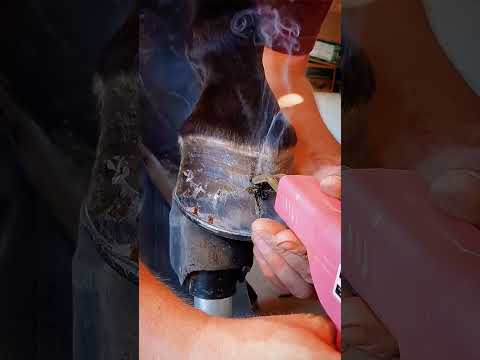
For superficial cracks that do not extend into sensitive tissue and do not move under load, the stress relief groove is the most effective and most underutilized tool. Using a Dremel rotary tool, a hoof knife, or a small hand file, the farrier cuts a small horizontal groove across the wall at the top of the crack — perpendicular to the crack's path. This groove interrupts the structural continuity of the horn fibers, preventing stress from propagating further up the wall. The crack below can then grow out without extending further. No patch, no composite, no filling required.
When a crack extends through significant wall thickness or moves under load, a composite patch is applied to bridge and stabilize the crack:
- The crack edges are debrided — all debris, necrotic tissue, and loose horn removed — and the wall surface around the crack is roughened with a grinder or rasp for adhesion
- A two-part acrylic or epoxy composite (Equilox, Vettec Superfast, or similar) is mixed and applied in layers to fill and bridge the crack
- Fiberglass mesh or fabric may be embedded in the composite layers to reinforce the repair and distribute load across a wider area
- Metal staples ("sutures") can be placed across the crack — small U-shaped steel pieces driven through the wall on either side of the crack — to mechanically hold the edges together and prevent movement
- The repair is finished flush with the wall and shod over with a shoe that distributes load away from the crack location
A deep quarter crack with movement and lameness requires the full repair sequence:
- Debride completely — all infected, loose, or necrotic material removed; the crack opened fully to assess depth
- Address balance first — the farrier corrects the medial-lateral imbalance that created the overloaded quarter; without balance correction, the repair will fail
- Apply composite with staples or mesh — bridge the crack, lock the edges together, restore wall structural integrity
- Shoe to unload the crack — a bar shoe (often with a quarter relief cut into the shoe web at the crack location) prevents the shoe from bearing on the wall directly below the crack; a full pad may protect the solar surface; the goal is to allow the repair to heal without load across the patched area
- Monitor every 5–6 weeks — the farrier reassesses the repair at each visit, reapplying composite as needed and adjusting the shoe until new horn has grown down past the crack site (typically 9–12 months for a coronary-band-to-ground regrowth)
Repairing the crack without correcting the underlying cause guarantees recurrence:
- Balance the foot — medial-lateral balance assessment; lower the high quarter that was bearing excess load; create even ground contact across both heels
- Reduce toe length — for toe cracks driven by long-toe leverage
- Address contracted heels — for quarter cracks in horses with narrow, contracted heel conformation; widen the heel region over successive trims
- Shorten the trim interval — 5–6 weeks for horses with crack history, not 8–10
Hoof Composite (Equilox / Vettec)
Two-part acrylic or polyurethane adhesive used to fill, bridge, and reinforce hoof cracks. Available in multiple hardnesses. Standard repair material for quarter cracks and deep toe cracks.
Hoof Staples / Sutures
Small U-shaped steel staples driven across a crack to mechanically hold the edges together and prevent movement. Used in combination with composite for quarter crack repair. Requires a drill and experienced farrier.
Fiberglass Mesh Reinforcement
Fiberglass cloth or mesh embedded in composite layers to reinforce crack repairs and distribute load. Increases patch durability and prevents the composite from cracking under repeated load.
Bar Shoe with Quarter Relief
A bar shoe with the web cut away or relieved at the quarter crack location. Allows the crack repair to heal without bearing load directly from the shoe. Most common therapeutic shoe for quarter crack management.
Filling a moving crack with composite without mechanically stabilizing it first is like painting over a rusting hole — it will fail quickly. A crack that moves under load must be stabilized with staples, correct shoeing that unloads the cracked wall, or both, before any filling or patching will hold. This is the most common reason crack repairs fail within the first shoeing cycle.
The Veterinarian's Role — When Cracks Become Medical
Most hoof cracks don't require a vet call. The vet becomes necessary when a crack is causing lameness, when infection has penetrated sensitive tissue, when pain management is needed for repair, or when an underlying systemic cause needs investigation.
When a cracked hoof causes visible lameness, a vet lameness evaluation determines whether the pain is coming from the crack itself, from an associated infection, or from an underlying structural issue (imbalance, laminitis, navicular) that the crack is a symptom of. Nerve blocks can localize the pain source. This matters because treating the crack without identifying an underlying cause means the crack — and the lameness — will return.
Deep quarter cracks that penetrate sensitive tissue frequently become infected — the crack acts as a channel for bacteria to reach the corium (sensitive laminae). Signs include black discharge, foul odor, swelling at the coronary band above the crack, and increasing lameness. The vet debrids the infected tissue, flushes the wound, and may prescribe:
- Systemic antibiotics — trimethoprim-sulfamethoxazole (TMS) or penicillin for established corium infections
- Topical antiseptics — chlorhexidine or iodine solution irrigation of the infected crack
- NSAIDs — phenylbutazone for pain management during treatment
A deep quarter crack repair involving debridement of infected sensitive tissue is painful enough that the horse may not tolerate the procedure without analgesia. The vet administers a palmar digital nerve block to desensitize the foot, allowing the farrier to perform thorough debridement and composite application without the horse pulling away. This collaboration — vet blocks the foot, farrier repairs the crack — produces far better outcomes than attempting a painful repair without pain control.
A horse that keeps cracking in the same location despite good farrier care and management may have an underlying cause that warrants investigation:
- Radiographs — rule out underlying bone pathology, laminitic changes, or coffin bone abnormalities that create abnormal wall loading
- Nutritional blood panel — assess zinc, copper, and selenium status in horses with persistently poor horn quality
- Metabolic testing — PPID or EMS can affect horn quality and white line integrity in ways that predispose to cracking
- Coronary band biopsy — rarely needed but can confirm coronary band damage or neoplasia in horses with persistent sand crack production from the same location
A hoof crack requires veterinary attention if: the horse is lame; there is black discharge or foul odor from inside the crack; there is swelling at the coronary band directly above the crack; the crack bleeds during loading; or the horse has had a crack in the same spot that keeps recurring despite correct farrier care. These signs indicate infection in sensitive tissue or an underlying problem that farrier care alone cannot resolve.
The Horse Owner's Role — Detection, Environment, Nutrition
The owner's role in hoof crack management is primarily preventive — managing the moisture environment, maintaining the nutrition that produces strong horn, and catching cracks early before they become deep. Once a crack is repaired, the owner protects the repair and monitors for signs of recurrence or infection.
Every hoof picking session is an inspection opportunity. Look specifically at:
- The hoof wall surface — any new hairline cracks, especially in the quarters
- The coronary band — any nicks, injuries, or swelling that could produce a sand crack
- Existing cracks — are they extending? Is there new discharge, odor, or discoloration?
- The white line at the sole — separation or crumbling that may indicate weakness where cracks can initiate
The single most controllable factor in crack prevention is moisture management:
- Avoid repeated wet-dry cycling — if the paddock is wet, don't alternate with hours on dry concrete; the expansion and contraction splits horn fibers
- Deep, dry bedding — hooves that stand in wet urine-soaked bedding all night become soft and weak; strip stalls regularly
- Hoof hardeners in wet seasons — Keratex Hoof Hardener, Venice turpentine applied to the wall surface maintains horn integrity during prolonged wet conditions; apply to the wall, not the sole
- Avoid sealing oils in dry conditions — petroleum-based hoof oils can prevent the wall from absorbing natural moisture; in very dry climates, a water-based hoof conditioner is more appropriate than an oil-based sealant
After your farrier applies a composite patch or quarter crack repair:
- Allow the composite to cure fully before turnout — typically 10–15 minutes, but follow your farrier's instruction
- Avoid deep mud turnout immediately after repair — wet, sucking footing can dislodge a fresh patch before it bonds fully to the wall
- Check the repair at each hoof picking — watch for the patch lifting, cracking, or developing new discharge underneath it
- Never attempt to pick or pry at a composite repair — if it appears to be lifting, call your farrier; attempting to remove it yourself damages the underlying horn
- Inform your farrier immediately if the horse goes lame after a repair — this may indicate pressure from the patch on sensitive tissue
Dense, quality hoof horn resists cracking far better than brittle, weak horn. Key nutritional support:
- Biotin 20mg/day — best-supported supplement for improving hoof horn quality; allow 6–9 months to see full effect
- Zinc and copper — essential for keratin cross-linking; often deficient in horses on grass hay diets; look for a balanced mineral supplement rather than individual minerals
- Methionine — sulfur-containing amino acid critical for strong horn; available in most complete hoof supplements
- Omega-3 fatty acids — reduce systemic inflammation and support membrane integrity in hoof tissue; ground flaxseed or fish oil are good sources
Keratex Hoof Hardener
Formaldehyde-based hoof hardener. Applied to the hoof wall surface, it cross-links horn proteins and toughens the outer wall. Best used preventively in horses prone to cracking. Apply every 3–5 days to the clean, dry wall surface — not the sole.
Complete Hoof Supplement (Biotin-Based)
Farrier's Formula, Equine Hoof Care, or similar. Contains biotin, methionine, zinc, and lysine. Commit to 9–12 months minimum. The most effective long-term prevention for horses with chronically poor horn quality.
Venice Turpentine
Traditional hoof hardener. Applied warm to the sole and white line area — antifungal, toughening effect on horn tissue. Particularly useful for softening prevention in wet conditions and white line disease prevention.
Hoof Boot (During Repair Healing)
A hoof boot worn during turnout in rocky or muddy conditions can protect a freshly repaired crack from trauma and contamination. Use only for specific protection periods — extended boot use traps moisture and can cause softening.
Prevention — Keeping Hoof Cracks From Forming
The majority of hoof cracks are preventable with consistent management. A horse that has cracked once is more likely to crack again — prevention is an ongoing commitment, not a one-time fix.
Regular Farrier Schedule
This is the single most effective crack prevention tool. A 5–8 week trim cycle removes weak, overgrown wall before it can crack and chip. Horses prone to cracking should be on the short end of this range — 5–6 weeks without exception.
Consistent Moisture Environment
Eliminate extreme wet-dry cycling. Maintain dry stall bedding, add gravel footing to wet paddock areas, and use hoof hardeners during prolonged wet seasons. Consistency matters more than any single product.
Hoof-Quality Nutrition Year-Round
Start a biotin-based complete hoof supplement before cracks appear and maintain it year-round. Horn quality takes 9–12 months to improve through the hoof capsule — preventive supplementation is always more effective than remedial supplementation after cracks have already formed.
Correct Hoof Balance Every Trim
Quarter cracks and toe cracks are often caused by imbalance. At every farrier visit, the trimmer should assess and correct medial-lateral balance — both heels at the same height, even ground contact across the foot. Imbalance caught and corrected before it causes a crack is far easier to manage than repairing the resulting quarter crack.
Footing Appropriate to the Workload
Horses working heavily on hard, rocky, or abrasive footing benefit from full pads or pour-in packing to protect the wall and sole from concussive cracking. Arena footing should be kept properly maintained — packed hard sand is nearly as damaging as road work without hoof protection.
Treat Coronary Band Injuries Promptly
Any injury to the coronary band — wire cuts, kicks, pasture wounds — should be treated immediately and monitored for scar formation. Coronary band scars produce permanent sand cracks. Early treatment of the wound and management of the resulting scar tissue can minimize the horn defect produced. Alert your farrier to any coronary band injury so they can monitor the new horn growth.
Hoof Crack Videos — Watch & Learn
See real crack repairs performed by experienced farriers — quarter crack repair, composite application, and severe crack restoration.